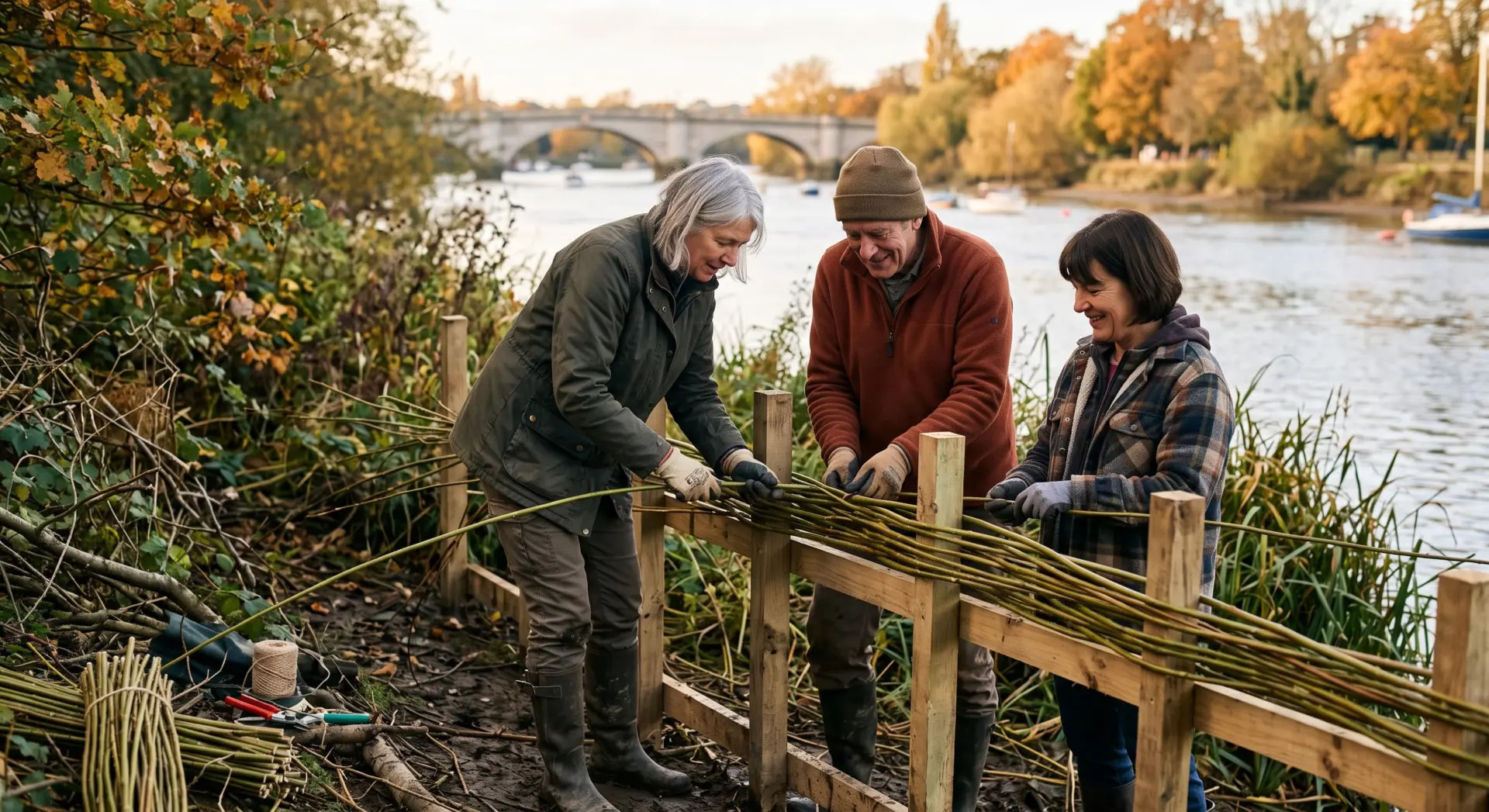
The Thames towpath near Kew is calling for volunteers this October to learn willow spiling workshops in Richmond, a traditional craft that has protected riverbanks for centuries. Three Tuesday morning sessions will teach you how to weave living willow into the riverbank to slow erosion, strengthen the shore, and create habitat for wildlife. It is the kind of practical, hands-on conservation work that connects you directly to the river you walk beside, and you will leave with a skill that has been passed down through generations of Thames watermen.
Thames Landscape Strategy is hosting three free workshops on 6, 13, and 20 October 2026, each running from 10am to 2pm.
What you will do during the workshops
Each session takes place along the Kew towpath, meeting at the end of Old Palace Lane.
You will work alongside experienced practitioners to build a living willow structure directly into the riverbank. The technique involves driving hazel stakes into the shore, then weaving pliable willow branches horizontally between them to create a flexible barrier that absorbs wave energy and traps sediment. As the willow takes root and grows, it becomes a permanent, self-renewing defence against erosion. The workshops are designed for complete beginners, and all tools and materials are provided. You will need sturdy footwear, outdoor clothing you do not mind getting muddy, and a willingness to work at the water’s edge.
The work is physical but satisfying, and by mid-afternoon you will see a tangible stretch of new riverbank taking shape under your hands.
Why willow spiling matters for the Thames
Willow spiling has been used on the Thames since at least the medieval period, when riverside communities relied on it to protect fields and footpaths from the river's winter moods.
Modern alternatives such as steel piling and concrete revetment are effective but expensive, visually intrusive, and offer little to wildlife. Willow spiling, by contrast, creates a graduated edge where water meets land, allowing invertebrates, fish fry, and wading birds to thrive. The technique also allows the bank to move and settle naturally, rather than locking it into a rigid profile that can fail suddenly under pressure. Thames Landscape Strategy has been reviving the craft across west London for more than a decade, training volunteers and riparian landowners to maintain their own stretches of river using methods that work with the landscape rather than against it.
In an era of increasing flood risk and declining biodiversity, these old techniques are proving surprisingly modern in their effectiveness.
What this means for you
If you have ever wanted to contribute directly to the health of the Thames, this is a rare opportunity to learn a traditional skill while doing practical conservation work. The sessions are free, but places are limited and Thames Landscape Strategy asks that you book in advance through their website. Each workshop runs for four hours, so you can attend one session or all three depending on your availability. The willow you plant this October will still be protecting the towpath in decades to come, a tangible legacy of a few autumn mornings spent working beside the river.
The Thames towpath between Kew and Richmond is one of the borough’s most cherished routes, and willow spiling offers a way to protect it that honours both heritage and ecology. If you can spare a Tuesday morning this October, you will gain a skill, meet like-minded neighbours, and leave the riverbank in better shape than you found it.
The stretches of towpath between Kew and Richmond are quietly losing ground to the river each winter, and willow spiling offers a gentler, more sustainable solution than hard engineering. Your work this autumn will help secure the path you and your neighbours depend on for daily walks.
Frequently asked questions
Do I need any previous experience to join the willow spiling workshops?
- No experience is required. The workshops are designed for complete beginners, and Thames Landscape Strategy provides all instruction, tools, and materials. You simply need to be comfortable working outdoors and able to manage light physical activity such as bending, kneeling, and handling branches.
What should I wear and bring to the workshop?
- Wear sturdy waterproof boots or wellies, as you will be working at the water’s edge and the ground can be muddy. Dress in layers and bring waterproof clothing in case of rain. Gloves are useful but not essential. You may also want to bring a packed lunch or snacks, as the session runs from 10am to 2pm.
Where exactly do the workshops meet?
- The meeting point is at the end of Old Palace Lane in Kew, where it meets the Thames towpath. This is a short walk from Kew Gardens station and easily accessible on foot or by bicycle. If you are driving, the nearest car park is at Kew Green.
Can I attend more than one workshop session?
- Yes, you are welcome to attend one, two, or all three sessions on 6, 13, and 20 October. Each workshop builds on the previous one, so returning volunteers will see the project develop and may take on more advanced tasks as the structure grows.
Useful resources
Castelnau Dentists
Castelnau Dentists is a well-regarded dental practice situated at 200 Castelnau in Barnes, SW13, serving the local community with patient-centred care delivered by a team of dentists and hygienists. The…
The Bench
The sounds of the seasons in Richmond
The sounds of the seasons in Richmond arrive before you see them. A swift’s scream high over the river in May tells you summer is coming. The first roar of a stag in Richmond Park means October has turned. These are the voices of the borough’s calendar. You learn them without trying. The dawn chorus […]
Local groups
Richmond Local History Society
The Richmond Local History Society is a community group dedicated to exploring and preserving the rich history of Richmond and its surrounding…
Richmond & Twickenham Photographic Society (RTPS)
The Richmond & Twickenham Photographic Society (RTPS) is a community-minded photography club serving enthusiasts across the Richmond upon Thames area, including Kew…
The Richmond Society
The Richmond Society is a civic and community organisation dedicated to preserving and enhancing the character of Richmond and its surroundings. It…